Most academic websites leave the personal out, which I think is a mistake.
In Bayesian inference you are required to declare your priors before examining the data, and they are treated as part of how the inference works rather than as an admission of bias. Researchers carry priors in much the same way, though we are rarely asked to state them. We bring assumptions about which questions matter, whose experiences are treated as generalizable, and what counts as evidence, and those assumptions are shaped by the life we lived before the work. Acknowledging them doesn't compromise the research; it's part of doing it carefully. The sections below are my attempt to be transparent about mine, and about the background and tensions that brought me to the questions I study.
early context & home.
I grew up in rural San Diego County, where neither of my parents had a four-year degree and most of the adults I knew worked in trades, small businesses, or service jobs. Academia wasn't something I inherited, and I ended up learning it from the outside in.
Being first-generation in academic spaces means I spend a lot of time translating between worlds that don't always recognize each other, which is a large part of why I try to keep my work legible to people outside the academy.

formative political years.
My mother was liberal, and my father was politically conservative but socially progressive in ways that came out of his Christian faith. They disagreed sharply on policy while still sharing a basic set of commitments about fairness and responsibility, and I spent most of my formative years learning about politics in that tension.
Growing up that way made me pay attention to how people talked about politics rather than only what they believed, and I have been asking versions of the same question ever since: what leads two people who share a household and most of a value system to attach themselves to opposing political coalitions, and how do faith, class background, and the community someone grew up in shape the political conclusions that end up feeling obvious to them?
soccer career.
Before I entered academia, my entire life revolved around soccer. I was part of the early wave of the ACL epidemic that disproportionately affects women athletes. I tore my ACL three times before finishing high school. My first surgery, in eighth grade, was botched by a surgeon who didn't take a young woman's athletic career seriously.
It took me a while to understand that this wasn't simply one surgeon's failure. The research, the protocols, and the recovery standards had all been built around male athletes, and women's sports medicine was largely an afterthought. Gender inequality in institutions was concrete to me long before I had any theoretical language for it.
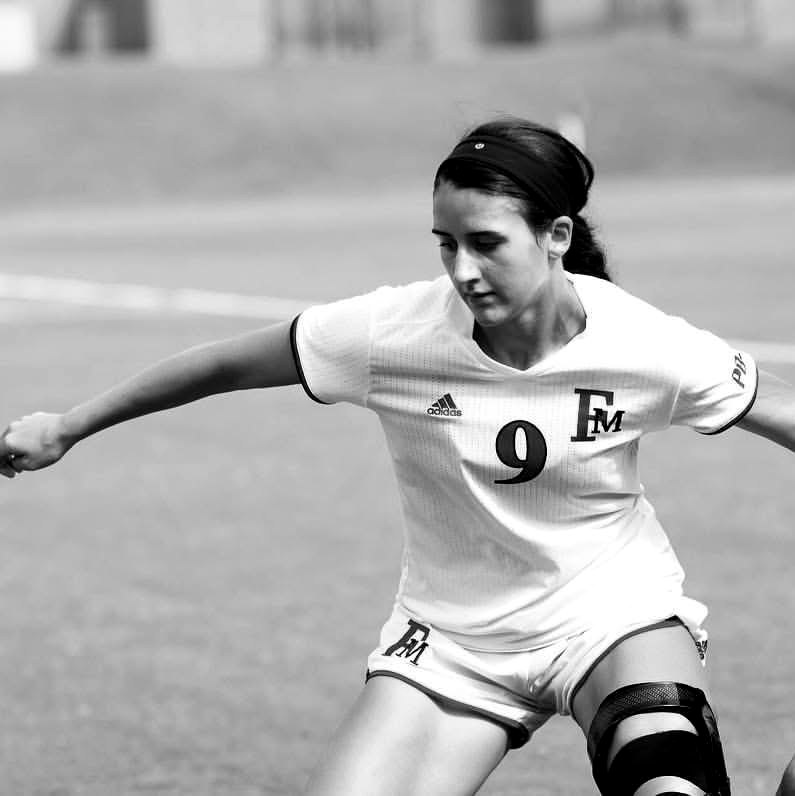
I rehabbed and eventually earned a scholarship to play college soccer at Francis Marion University, a small state school in Florence, South Carolina. Like most recruited athletes, I went where the scholarship was rather than where the rankings pointed, and it took me about as far from home as I could have gone. The school was pedagogy-focused, with small classes and faculty who knew my name and cared about what happened to every student, and I still think about that environment when I design my own courses.
what I study now.
I sit on the cusp between millennial and Gen Z, which meant watching the early internet turn into the platform environment we have now. Friends and neighbors drifted into media spaces that functioned more like pipelines than communities, and I noticed how much political content was traveling through entertainment, sports, and lifestyle media without being labeled as political at all.
That's more or less how I ended up studying what I call gendered media spaces. My current work asks how digital information environments sort people by gender before they encounter explicitly political content, and what that sorting does to political identity and vote choice. In the podcast ecosystem, preferences for masculine or feminine content, rather than ideology, sort audiences and expose men and women to systematically different political messages, which means that people consuming media for entirely non-political reasons end up politically informed in very different ways.
A good deal of what I end up working on starts with family and friends rather than just the literature. It might be noticing what my little brother is seeing online, or wanting our modeling approaches to actually match how the people I know talk about their own lived experience. It keeps me grounded in questions that matter to the public, and it makes my research easier to communicate to a general audience.